 comparison
Semaglutide vs Tirzepatide: Weight Loss Results Compared
Table of Contents
- Semaglutide vs Tirzepatide: Head-to-Head Efficacy Comparison
- Clinical Trial Results: Weight Loss Percentages and Outcomes
- Semaglutide vs Tirzepatide Side Effects: What to Expect
- Tirzepatide Weight Loss Timeline: When to Expect Results
- How to Qualify for Weight Loss Injections
- Managing Long-Term Weight Maintenance After Treatment
- Which Medication Is Right for You
- Frequently Asked Questions
Last Updated: August 15, 2026
Semaglutide vs Tirzepatide: Head-to-Head Efficacy Comparison
The fundamental difference between semaglutide and tirzepatide comes down to mechanism of action. Semaglutide works as a GLP-1 receptor agonist, reducing appetite and slowing gastric emptying. Tirzepatide is a dual GLP-1 and GIP receptor agonist, activating two separate pathways simultaneously. This dual mechanism produces clinically meaningful differences in weight loss outcomes.
Semaglutide typically produces weight reductions of 13-15% of baseline body weight over 68 weeks. Tirzepatide demonstrates weight reductions between 16-22.5% over comparable timeframes, depending on the final maintenance dose.
The practical question is straightforward: if tirzepatide produces better results, why choose semaglutide? The answer involves tolerability, cost, availability, and individual response variability. Some patients experience more manageable gastrointestinal side effects with semaglutide's single-pathway approach. Insurance coverage also differs significantly, with semaglutide (Wegovy) having broader formulary inclusion in many plans.
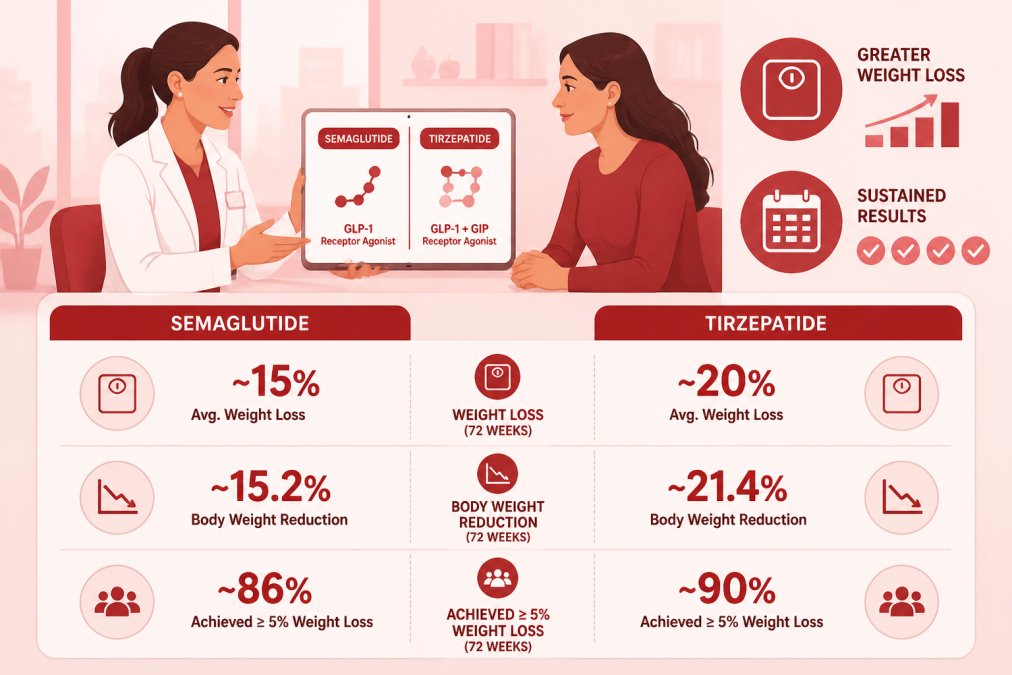
Individual factors, baseline BMI, comorbidities, medication history, and personal tolerability thresholds, determine which medication produces superior outcomes for a specific patient.
Clinical Trial Results: Weight Loss Percentages and Outcomes
Semaglutide's efficacy data derives from the STEP trials (Semaglutide Treatment Effect in People with obesity), which enrolled over 4,500 participants. STEP 3, examining the 2.4 mg maintenance dose, showed mean weight loss of approximately 14.9% from baseline.
Tirzepatide's efficacy data comes from the SURMOUNT trials, which enrolled similarly large populations. SURMOUNT-1 demonstrated mean weight loss of 22.5% with the 15 mg dose, a statistically significant advantage over semaglutide.
When head-to-head analyses are conducted by independent researchers, tirzepatide consistently shows superior weight reduction across most demographic subgroups, with differences typically ranging from 5-8 percentage points in tirzepatide's favor.
Both medications improved insulin sensitivity, reduced blood pressure, and lowered inflammatory markers. A critical finding: the proportion of participants achieving clinically meaningful weight loss (≥10% reduction) was substantially higher with tirzepatide. In SURMOUNT-1, approximately 85% of tirzepatide-treated participants achieved ≥10% weight loss compared to approximately 60% in semaglutide studies, representing a meaningful difference in real-world efficacy.
Semaglutide vs Tirzepatide Side Effects: What to Expect
Both medications produce similar categories of adverse events, though frequency and severity can vary. The most common side effects affect the gastrointestinal system: nausea, vomiting, diarrhea, and constipation. These typically emerge during titration and often improve as the body adapts.
Nausea represents the most frequently reported adverse event. With semaglutide, nausea occurs in approximately 25-40% of patients during early treatment. With tirzepatide, nausea occurs in roughly 12-31% of patients. Tirzepatide's nausea tends to be more intense during initial dose escalation but diminishes more rapidly in some patient populations.
Vomiting and diarrhea occur less frequently but can be more disruptive. These gastrointestinal effects are dose-dependent; higher maintenance doses correlate with higher adverse event rates. Dietary modifications (smaller, more frequent meals; reduced fat intake) help some patients manage these effects.
Less common but clinically important side effects include pancreatitis risk and gallbladder complications. The FDA requires black-box warnings for both medications regarding thyroid C-cell tumors based on rodent studies, though human thyroid cancer risk remains unproven. Patients with personal or family history of medullary thyroid carcinoma or multiple endocrine neoplasia type 2 are contraindicated from both medications.
Dehydration risk increases with both medications due to gastrointestinal fluid losses. Patients must maintain adequate hydration and monitor for signs of volume depletion, particularly during titration phases.
Most patients tolerate one medication better than the other. Individual tolerability cannot be predicted reliably before treatment initiation, making dose escalation protocols and close monitoring essential during the first 8-12 weeks.
Tirzepatide Weight Loss Timeline: When to Expect Results
The timeline for observing meaningful weight loss differs between semaglutide and tirzepatide, though both require patience. Tirzepatide typically starts at 2.5 mg weekly, with escalation to 5 mg, 10 mg, and finally 15 mg at 4-week intervals.
During the first 4 weeks on the starting dose, weight loss is minimal, often 1-2 pounds. This represents dose titration, not therapeutic effect. Patients frequently experience side effects during this phase without corresponding weight reduction.
By week 8-12, as patients reach intermediate doses (5-10 mg), weight loss accelerates noticeably. Most patients report losing 2-4 pounds per week. Appetite suppression becomes pronounced.
The most dramatic weight loss typically occurs between weeks 12-24, as patients approach their target maintenance dose. Weight loss rates of 1-3 pounds per week are common. By week 20, most patients have lost 10-15% of baseline body weight.
Plateau effects emerge around week 24-32. Weight loss velocity slows as the body adapts and the caloric deficit narrows. This plateau is normal and does not indicate medication failure. Continued slow weight loss typically occurs through week 52-68, with cumulative weight loss reaching maximum levels by 12-16 months.
Setting appropriate expectations, emphasizing that weeks 1-4 are titration phases, not treatment phases, improves adherence and reduces premature discontinuation.
How to Qualify for Weight Loss Injections
FDA approval criteria establish clear eligibility thresholds. Patients must have a BMI of 30 kg/m² or higher (obese category) OR a BMI of 27 kg/m² or higher with at least one weight-related medical condition such as hypertension, type 2 diabetes, dyslipidemia, sleep apnea, or cardiovascular disease.
The BMI calculation is straightforward: divide weight in pounds by height in inches squared, then multiply by 703. A 5'6" person weighing 200 pounds has a BMI of approximately 32, meeting obesity criteria.
Medical evaluation requires assessment of contraindications. Patients with personal or family history of medullary thyroid cancer cannot receive either medication. Patients with multiple endocrine neoplasia type 2 (MEN2) are also contraindicated. Pregnancy and breastfeeding preclude use of both medications.
Kidney and liver function assessment becomes important because both medications require dose adjustment or avoidance in severe renal impairment. Patients with acute pancreatitis or gallbladder disease require careful evaluation.
Psychological readiness and behavioral commitment matter clinically. These medications work best when combined with reduced-calorie diets and increased physical activity. Patients unwilling to modify eating patterns often experience suboptimal results and higher discontinuation rates.
At PuraBella Wellness, the qualification process involves detailed medical history, anthropometric measurements, laboratory assessment, and medication review to ensure patients are appropriate candidates.
Managing Long-Term Weight Maintenance After Treatment
The most challenging phase isn't weight loss, it's weight maintenance after discontinuation. Most patients regain weight when these medications are stopped, with studies showing regain of 50-80% of lost weight within 12 months of discontinuation.

The physiological basis is straightforward: these medications suppress appetite through specific receptor pathways. When discontinued, those pathways revert to baseline function, and appetite returns to pre-treatment levels.
Behavioral and dietary changes made during treatment represent the best insurance against rapid weight regain. Patients who establish sustainable eating patterns, increase physical activity, and address underlying eating behaviors during treatment maintain weight better after discontinuation than those relying entirely on pharmacotherapy.
Some practitioners recommend indefinite continuation for patients with significant obesity and weight-related comorbidities, treating obesity as a chronic disease requiring ongoing pharmacotherapy. Insurance coverage and patient preferences determine feasibility.
Psychological factors significantly influence weight maintenance success. Patients who develop improved body image, increased self-efficacy, and sustainable lifestyle habits during treatment maintain weight better than those viewing the medication as temporary.
Metabolic health markers often improve beyond what weight loss alone would predict. Many patients experience sustained improvements in blood pressure, lipid profiles, and glucose control even with modest weight regain after discontinuation.
Which Medication Is Right for You
Choosing between semaglutide and tirzepatide requires weighing efficacy, tolerability, cost, and individual health circumstances. Tirzepatide's superior weight loss results make it the preferred first-line choice for most patients seeking maximum weight reduction.
However, semaglutide remains appropriate for several populations. Those with gastrointestinal sensitivity may tolerate semaglutide's single-pathway mechanism better. Patients with insurance coverage favoring semaglutide or those unable to afford tirzepatide's higher cost may achieve excellent results with semaglutide. Patients with mild-to-moderate obesity (BMI 27-32) often achieve their weight loss goals with semaglutide.
Individual metabolic characteristics matter as well. Some patients respond excellently to semaglutide alone, while others benefit substantially from tirzepatide's additional GIP pathway activation. These differences cannot be predicted reliably beforehand.
Comorbidity profiles influence medication selection. Patients with type 2 diabetes may experience greater glycemic benefits with tirzepatide. Those with significant cardiovascular disease may benefit from either medication. Those with gallbladder disease or severe pancreatitis history require careful evaluation.
The practical approach involves starting with the medication most likely to succeed based on medical history and patient preferences, then assessing response and tolerability over 8-12 weeks. If inadequate weight loss occurs or intolerable side effects emerge, switching to the alternative medication is reasonable.
| Medication | Average Weight Loss | Mechanism | Common Side Effects | Best For |
|---|---|---|---|---|
| Semaglutide | 13-15% | GLP-1 receptor agonist | Nausea, diarrhea, constipation | Patients with GI sensitivity; those with good insurance coverage |
| Tirzepatide | 16-22.5% | GLP-1 + GIP receptor agonist | Nausea, diarrhea, vomiting | Patients seeking maximum weight loss; those with mild GI tolerance |
The choice between semaglutide and tirzepatide weight loss medications ultimately depends on your individual health profile, tolerability patterns, and weight loss goals. At PuraBella Wellness, our team provides comprehensive medical evaluation to determine which medication aligns with your specific circumstances. We combine pharmacotherapy with personalized lifestyle support and monitoring to maximize both weight loss results and long-term weight maintenance. Book a consultation to discuss which approach best supports your wellness journey.
Frequently Asked Questions
Which loses weight faster, semaglutide or tirzepatide?
Tirzepatide typically produces faster and greater weight loss than semaglutide. Clinical trials show tirzepatide users achieved 16-22.5% body weight reduction compared to semaglutide's average of 15% weight loss. However, individual results vary based on starting weight, dosage, lifestyle factors, and how your body responds to the medication. Both are GLP-1 receptor agonists, but tirzepatide also activates GIP receptors, which may enhance its weight-loss effect. Your provider can help determine which is better suited to your specific health profile and goals.
How long does it take to see significant weight loss on tirzepatide?
Most people begin noticing weight changes within 4-8 weeks of starting tirzepatide, though initial weight loss is often modest. Significant results typically appear between 3-6 months as your dose escalates through the titration schedule. The medication reaches full therapeutic effect after 16-20 weeks at the maintenance dose. Maximum weight loss is usually achieved around 52 weeks of treatment. Results depend on your starting weight, adherence to reduced-calorie diet and exercise, and individual metabolism. Consistent progress is more important than rapid results; sustainable weight loss supports long-term health outcomes.
What are the main differences in side effects between semaglutide and tirzepatide?
Both medications cause similar gastrointestinal side effects, including nausea, vomiting, diarrhea, and constipation. Tirzepatide users report slightly higher rates of nausea early in treatment, particularly during dose escalation. Semaglutide may cause more constipation in some patients. Both can cause decreased appetite, which is the intended effect but can lead to insufficient nutrient intake if not managed carefully. Serious adverse events are rare with both medications. Side effects typically improve within 2-4 weeks at each dose level as your body adjusts. Staying hydrated, eating small frequent meals, and gradual dose increases help minimize gastrointestinal distress. Always report persistent or severe symptoms to your healthcare provider.
What qualifications do I need to be eligible for weight loss injections?
To qualify for semaglutide or tirzepatide, you typically need a BMI of 30 or higher (obesity), or 27 or higher with at least one weight-related medical condition such as type 2 diabetes, high blood pressure, or heart disease. Your provider will review your medical history, current medications, and any contraindications. These medications are not suitable if you have a personal or family history of medullary thyroid cancer or multiple endocrine neoplasia type 2. Pregnancy and breastfeeding are contraindications. A comprehensive health assessment, including blood work, helps determine if either medication is safe and appropriate for you. Your provider at a medically supervised program can evaluate your individual circumstances and recommend the best option.
What happens to weight loss after I stop taking semaglutide or tirzepatide?
Weight regain is common after discontinuing either medication if lifestyle changes are not maintained. Studies show that without sustained dietary modifications and physical activity, patients regain approximately 50% of lost weight within one year. The key to long-term weight maintenance is establishing permanent habits during treatment: consistent exercise, balanced nutrition, adequate sleep, and stress management. Some patients benefit from periodic medication use to prevent significant weight rebound. A comprehensive program that combines medication with behavioral coaching, nutritional guidance, and ongoing support significantly improves long-term outcomes compared to medication alone. Discussing a maintenance strategy with your healthcare provider before stopping treatment helps protect your progress.